Value-creating teaching in in-company training:
Agile Teaching for you or your organization
Agile teaching supports goals that arise from the training needs of employees, the necessary changes in teams or managers.
Contact Agile Learning
Follow us


What would happen if agility also found its way into fixed learning content?
Agile teaching can be used when goals or topics are brought to a group of individuals from outside. It provides support when individuals from teams and organizations deal with topics that arise from a training requirement or necessary changes in everyday working life.
For example, a team with accounting tasks could introduce a new accounting tool that all team members must be able to use. Or there is a training requirement due to legal regulations, such as data protection information, which must be implemented company-wide. Agile teaching can therefore be a useful addition to agile learning.

- Efficient further training
- Use the learner’s prior knowledge & experience
- Responding better to changes in the organization
Agile teaching:
Your path to predetermined skills
Agile teaching is an approach that applies the principles of agility to the educational process in order to promote more flexible, dynamic and collaborative learning. It focuses on continuous adaptation to change, iterative learning cycles and close collaboration between teachers and learners. The aim is to make the learning process more effective and practice-oriented by reacting more quickly to new requirements, actively incorporating feedback and strengthening self-organization and independent learning. This method not only promotes individual growth, but also helps teams and organizations to continuously develop and remain adaptable. Want to learn more about agile teaching? We are always here for you.
Advantages of agile teaching
Agile teaching methods offer significant advantages for the individual learner as well as the entire team and organization, which should not be underestimated. They can play an essential role in the transformation processes of your organization and contribute as a decisive cogwheel to success.
The learners are picked up in their learning process where they are with their previous knowledge.
Your own previous knowledge and personal experience is brought in and meaningfully linked with new knowledge.
In addition to the learning content, the learner’s inner attitude towards the topic and thus their mindset also changes.
As part of a team, the individual also learns what their fellow learners want to know. You can exchange ideas with them and learn from them.
With predefined teaching content, learners experience themselves as self-effective and can act in a self-determined way.
By involving learners in the development of content, an organization finds out exactly what employees need – and where their strengths lie.
By working according to agile principles, an organization receives regular feedback on the changing needs of its employees and can react better to changes at an organizational level. Certain developments can even be predicted in this way.
The first step is always a concept of agile teaching that is adapted to the requirements.
A detailed analysis is the necessary basis for designing learner-centered teaching concepts that offer added value for both learners and companies.
Agile requirements engineering combined with the methodology of modern teaching and learning research provides a good starting point for the subsequent design of an agile teaching and learning setting. This allows us to gain insights into who should be interviewed and, above all, how. In this way, we obtain as complete a picture as possible of the learners, but also of the subsequent application processes and the content to be conveyed.
Sound analysis & conception

Minimum Viable Product (MVP)
Implementation according to agile principles
Implementation according to agile principles in the sense of a minimum viable product makes it possible to create added value for learners at a very early stage: their valuable feedback is integrated into further development, thus ensuring a tailor-made solution.

Workshop
Teaching story mapping
Agile teaching: Designing teaching settings with teaching stories
With agile teaching story mapping, we introduce you to a method with which you can present the teaching topic clearly and at the same time open up degrees of freedom for the learners and promote self-organization.
In this workshop, we will show you how to identify and specify teaching needs and formulate them as teaching stories. We will also present an example of an agile teaching setting that was designed with the help of teaching stories. Together and interactively, we will derive concrete steps for implementation for your practice and your context.

Improvement through clear criteria
Continuous feedback and adapting the concept to changing conditions is an important part of continuous improvement. This is how we achieve the highest possible quality.

Who learns? What is learned? How is learning done?
Our agile teaching concepts are essentially based on these three central questions. The “who” refers to the different groups of learners, their specific requirements and how content and teaching formats can be used in a way that is most conducive to learning.
The “how” refers to the processes in which the knowledge will later be used. Teaching processes, methods and forms should reflect the work processes of the learners and be interwoven as far as possible – consequently, this fit should already be taken into account in the design. For example, if the teaching approach is to be used to support an agile transformation, it makes sense to also use agile elements in the teaching concept in order to further facilitate the transformation for learners.
The “what” refers to the learning content, which can be constantly adapted and ideally offered in different formats to better meet the individual needs of learners.

Agile teaching is based on the following 4 principles:
Mindset-supporting concept: The learners’ inner attitude towards a topic is strengthened.
Focus on the individuality of learners: learners are met where they are at the moment.
Individual and needs-based content: The content is created in iterative cycles in close cooperation with the customer.
Development and implementation of the agile teaching/learning concept according to agile principles: This enables the continuous improvement of content and the structure of the teaching/learning concept.
podcast
Agile teaching
I Want Change Podcast Episode 6: The sixth episode of our podcast is all about agile teaching concepts and how they differ from traditional ones. In exchange with her colleagues Dr. Theresa Heublein and Max Höldl, Inez discusses why an agile approach is beneficial when designing teaching concepts, what tips and tricks need to be considered, and what is meant by outcome vs. output.

From our experience
References & contributions
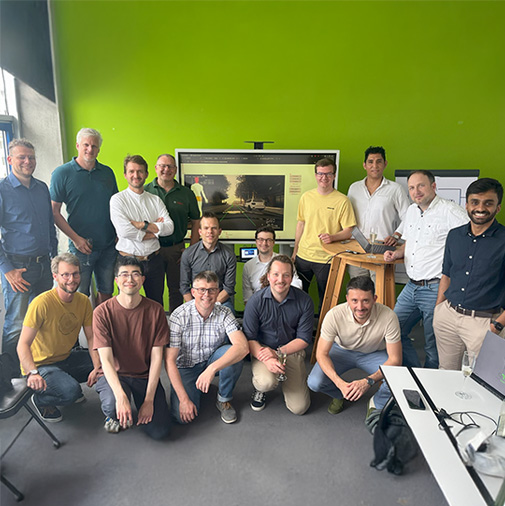
ATTENTION funding project
ATTENTION is a research project funded by the German government. In cooperation with a consortium of 5 German project partners (OEMs, suppliers, technology partners, research institutes), methods are being developed in the field of autonomous driving to predict the risk of accidents in real time and to limit damage.

Agile learning coach training
With the help of the so-called agile learning approach, we enable you to revolutionize learning coaching and meet the individual needs of your learners. Find out more about training to become an agile learning coach now!
Sounds good?
Arrange a free initial consultation now and benefit from the numerous advantages of agile teaching.